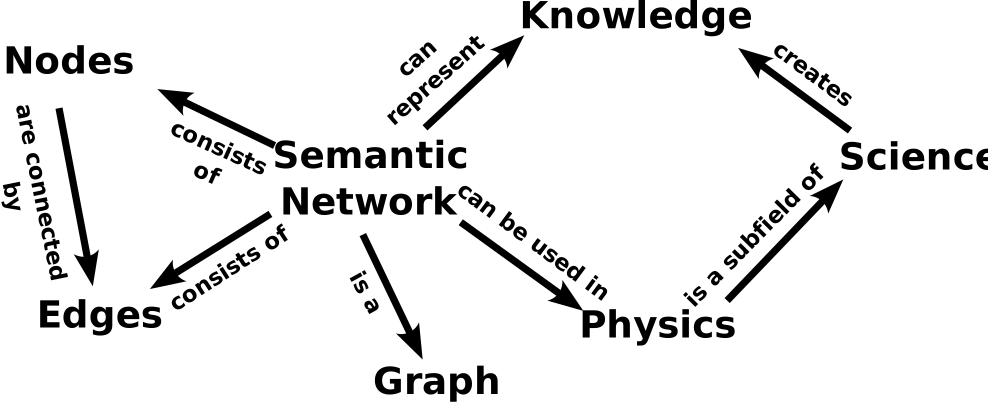
What is a semantic network
A semantic network is a mathematical graph that represents some abstract meaning. [^fleh] [^sowa] It consists of nodes that represent concepts and edges that represent relationships between these concepts. Semantic networks are often used as a knowledge base that can store information about various topics.
The term “knowledge graph” that is also quite common in the context of knowledge representation was originally assigned to semantic networks with a restricted set of connection types but is now also used with a broader meaning so that the boundaries between semantic networks and knowledge graphs are now blurred [^mccuscer].
There are many different types of semantic networks [^sowa]. They differ in what kind of concepts and what kind of connections are allowed and how their structure is to be interpreted in terms of meaning. Some consist of directed edges while others are non directed graphs. Some of them are organized as a tree structure while others are not hierarchical. Some are mathematically formal while others only suggest a freely interpretable meaning. Some allow a wide range of possible connections while others are restricted to a fixed set of edge types. There is a lot disagreement in the literature about the question what counts as semantic network and what does not [1]. Some sources also list neural networks as examples for semantic networks. [^sowa]
One very common type of a semantic networks, that is easy to read and understand by humans is a network consisting of semantic triples of natural language.